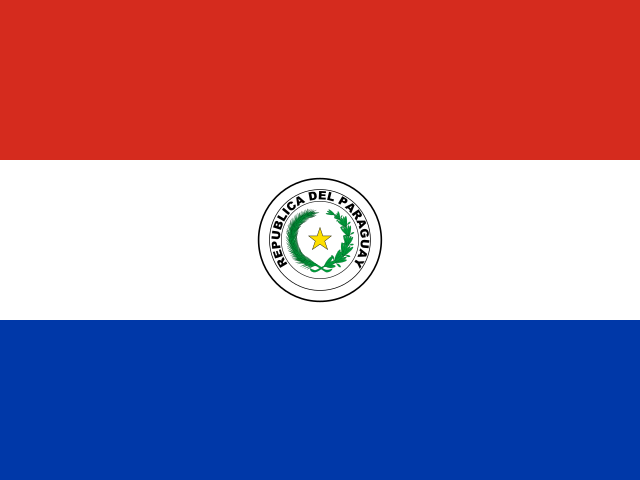
 Trademarks in Paraguay
Competent Authority
The national authority responsible for intellectual property administration and trademark registration in Paraguay is the National Directorate of Intellectual Property (Dirección Nacional de Propiedad Intelectual - DINAPI), operating under Law No. 1,294/1998 on Trademarks. The system is national. The official working language for all filings and administrative proceedings is Spanish.
International Treaties
Paraguay is a member of the Paris Convention for the Protection of Industrial Property and the World Intellectual Property Organization (WIPO). However, Paraguay is not a member of the Madrid System (neither the Madrid Agreement nor the Madrid Protocol); therefore, international registrations via the Madrid route cannot designate Paraguay, and applications must be filed directly through national procedures with DINAPI.
Who May Apply & Representation
Any natural or legal person, domestic or foreign, may apply for a trademark registration. Foreign applicants or entities not domiciled in Paraguay must be represented by a local representative or legal agent. Representation requires a Power of Attorney (POA). Under DINAPI practice, a Power of Attorney must be notarized and can generally be submitted within a strict statutory deadline of 60 business days following the initial filing date.
Online Filing & Search Databases
DINAPI provides digital channels for administrative management and electronic filing. Public trademark availability searches to identify prior conflicting marks can be conducted through the official online database maintained by DINAPI.
Protectable Trademark Types
Under Paraguayan trademark law, protectable signs include words, names, figurative elements, mixed marks, logotypes, and three-dimensional shapes, provided they possess distinctiveness. Transliteration or Spanish translation is required by examiners for terms expressed in foreign languages or non-Latin characters.
Classification System
Paraguay applies the Nice Classification system for goods and services. Multi-class applications are not permitted; a separate, independent application must be filed for each individual Nice class of goods or services.
Examination Procedure
DINAPI performs an initial formal examination of the application for completeness and legal compliance. Following publication and the subsequent opposition period, a substantive examination is carried out to evaluate absolute grounds for registrability and relative grounds (conflicts with prior rights).
Publication & Opposition
Once an application clears initial formal review, it is ordered for publication (traditionally published in local newspapers for three consecutive days as prescribed by local administrative practice). Any third party with a legitimate interest may file an administrative opposition within 60 business days following the final day of publication.
Timelines
For a straightforward application process that encounters no official office actions or third-party oppositions, the average timeframe from initial filing to the final grant and issuance of the registration certificate is approximately 8 to 12 months.
Duration & Renewal
A trademark registration in Paraguay is valid for 10 years, counted from the date of registration (grant date). Registrations can be renewed indefinitely for successive 10-year periods. Renewal applications must generally be filed within the final year prior to expiration, or during a statutory grace period subject to late penalties.
Use Requirements & System Type
Paraguay operates under a first-to-file priority system, where registration establishes primary legal ownership. However, registered trademarks are subject to statutory use requirements: a trademark is vulnerable to cancellation actions for non-use if it has not been genuinely used in commerce in Paraguay for a continuous period of 5 consecutive years.
Post-Registration Procedures
Recorded changes concerning the owner's corporate name, legal address, assignments (ownership transfers), and licensing agreements must be officially registered with DINAPI. Recording assignments and licenses is legally mandatory to ensure full validity and enforceability against third parties.
Legal Remedies & Enforcement
Cancellation actions for non-use, invalidity petitions, and administrative appeals against DINAPI decisions are managed through administrative pathways or specialized courts. Infringement claims, civil damages, and penal measures against counterfeiting are pursued through ordinary judicial courts, alongside border intervention options available via customs authorities.
This article is for informational purposes only and does not constitute legal advice or consultation. To receive personalized and in-depth guidance tailored to your specific situation, we invite you to schedule a consultation.
Talk to a specialist
The first consultation is free. Tell us what you need and when suits you, and we reply to agree a time.
What helps us answer well
- The name or logo you want to protect
- What you sell or offer under it
- The countries where you work or plan to
- Whether you already have an application or registration
- Any date you need to meet